


What If What You Think Truffle Tastes Like… Isn’t Actually Truffle?
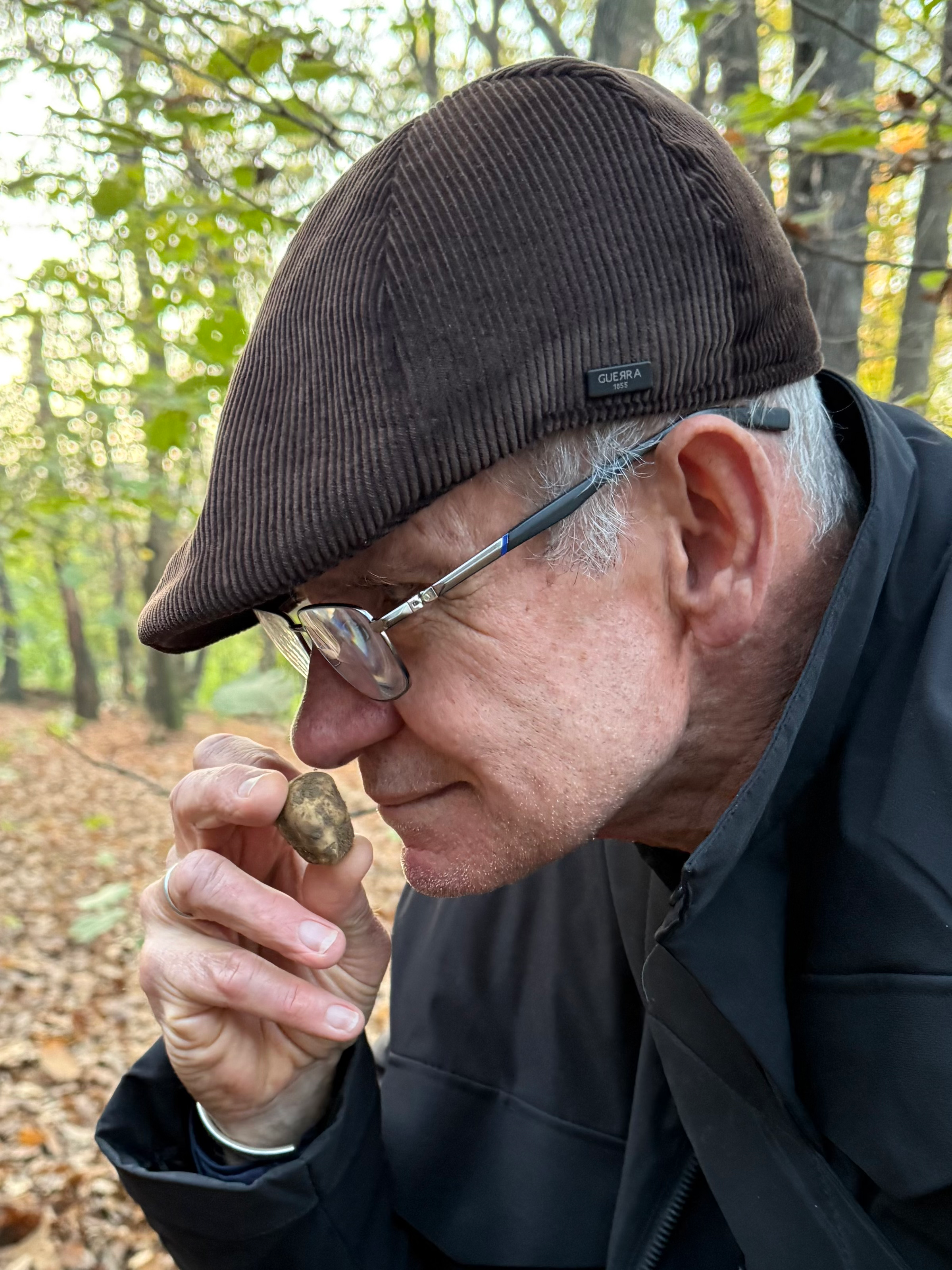
There is something rather strange happening in the world of truffles.
The fresh truffle is one of nature's most complex and extraordinary foods. Its aroma is the result of a bewildering mixture of volatile compounds working together to create something our brains recognise simply as “truffle”.
A fascinating new scientific review, What do we really know about aroma and nutritional profile of truffles?, takes a critical look at what we actually know about truffle aroma.
And it raises some questions that I find rather difficult to ignore.

A truffle is not a molecule
One of the most important points the authors make is that genuine truffle aroma is not simply the result of one magical “truffle molecule”.
Take the extraordinary Tuber magnatum, the Italian white truffle.
One compound, bis(methylthio)methane (BMTM), also known as 2,4-dithiapentane, is an enormously important contributor to its characteristic aroma. But it is not alone. Other compounds, including 3-methylbutanal, 1-pyrroline and methional, also contribute to the overall sensory experience.
The distinction matters.
Synthetic BMTM can reproduce an important component of the aroma of a white truffle. But BMTM is not the complete aroma of a truffle. The authors specifically conclude that flavour formulations based solely on BMTM are unlikely to reproduce the full complexity of T. magnatum.
About 300 compounds—and that's only the beginning
There is another fascinating complication.
Scientists can use techniques such as gas chromatography-mass spectrometry to identify enormous numbers of volatile compounds in food. In truffles, around 300 volatile compounds have been identified. But finding a chemical doesn't necessarily mean that it contributes significantly to what we actually smell.
Only a fraction of those compounds are known to be odour-active, and different compounds can have dramatically different odour thresholds. A compound present in tiny quantities can have an enormous influence on our perception, while another present in much greater quantities may barely register.
This is why simply producing a list of chemicals doesn't tell us what something actually smells like.
Think about a strawberry. We don't experience a strawberry because it contains one chemical that says “strawberry” to our brains. We experience it because a symphony of compounds interacts to produce the aroma and flavour we recognise.
Coffee is the same. So is wine.
And, apparently, so is truffle.
The authors argue that understanding truffle aroma requires chemical analysis to be combined with human sensory analysis, including techniques such as gas chromatography-olfactometry and the broader field of “sensomics”.
And here's the really interesting part:
We still don't have enough of this research.
What happens when you process a truffle?
The review also examines something that is particularly relevant to the growing world of truffle products: what happens to the aroma when we preserve or process the truffle?
Freezing, freeze-drying, drying and canning all change the aroma profile of Tuber melanosporum.
In one study, freeze-drying resulted in roughly a 40 per cent reduction in the intensity of what was described as “typical truffle aroma”. Other preservation methods produced new sensory characteristics. Notes reminiscent of baked potato, nuts and seeds appeared that were barely perceptible in fresh truffles. None of this means that processed truffle is necessarily bad. But it does raise an interesting question.
If processing changes the aroma of genuine truffle, and flavourings are then added to processed products to compensate for that loss, how much of the sensory experience in the finished product is actually coming from the truffle?
The paper doesn't answer that question definitively.
But it establishes that it is a scientifically legitimate question to ask.
Is synthetic BMTM the problem?
Interestingly, the answer isn't as simple as “chemicals bad, truffle good”.
The authors point out that synthetic BMTM is chemically indistinguishable, in its sensory effect, from the BMTM that occurs naturally in truffle. The molecule isn't an inferior version simply because it was produced synthetically. The more interesting distinction is between one dominant aroma compound and the complex mixture of compounds produced by a genuine truffle.
And the authors explicitly say that further comparative sensory research is needed to determine just how well BMTM-based flavourings reproduce the aroma of fresh truffle.
That, to me, is a much more interesting question than whether truffle oil “contains chemicals”.
Of course it contains chemicals.
So does a truffle.
The question is which chemicals, in what combinations, at what concentrations, and what sensory experience do they collectively create?
You have to ask though, could humans ever achieve what nature has done over millennia of slow fungal evolution?
Not all truffles smell the same
There is another point that I think deserves much more attention. Tuber magnatum isn't simply a stronger version of Tuber melanosporum.
Their aroma chemistry is substantially different even though BMTM is use interchangeably in selling oils labeled as black winter truffle and oils labeled as white winter truffle.
In tuber magnatum, BMTM is a dominant contributor, producing that powerful sulphury, garlic-like character for which the Italian white winter truffle is famous. In tuber melanosporum, our prized black winter truffle, has a very different chemical signature, involving compounds such as dimethyl sulphide, dimethyl disulphide, diacetyl, p-cresol, 1-octen-3-one and 1-octen-3-ol. Together they contribute an extraordinarily complex combination of sulphurous, mushroom, buttery, cheesy and even animal or leathery characteristics.
And Tuber borchii (the whitish or spring truffle) has yet another profile, with thiophene derivatives playing an important role.
So when we talk about “truffle flavour”, we need to ask:
Which truffle?
Because there isn't one universal truffle aroma.
And then things get really interesting
This is where the science of truffle aroma intersects with something I have written about before: the extraordinary influence of our first sensory experience.
Our brains don't experience the world as a blank canvas. Every encounter is interpreted in the context of what we have experienced before. Our first experience of a smell, taste or flavour can therefore be remarkably influential because it begins to establish a mental template, a set of expectations against which future experiences are unconsciously compared.
Once that template is established, our brains use it to help interpret what comes next. And importantly, much of this happens before we are consciously aware that we are making a judgement. We don't simply experience something and then decide what we think about it; our brains are constantly using previous experience to predict and interpret what we are about to experience.
This is one of the fascinating principles of perception: we don't just taste with our mouths; we taste with a brain that has a memory.
Which brings me back to truffle.
The review discusses research into consumer preferences that I found particularly intriguing.
Consumers were given products containing high-value Tuber melanosporum, lower-value truffles plus flavouring, or flavouring alone. Those accustomed to eating fresh truffles tended to prefer products containing the high-value T. melanosporum. But people who had never previously consumed fresh truffles tended to prefer products containing the added truffle flavouring, or even products without real truffle.
The authors suggest one possible explanation: people may have learned to associate the intense BMTM flavour with “truffle”, despite BMTM being naturally absent from black truffle species such as T. melanosporum.
Now, that is a remarkable possibility which I would have never seen coming, or did I?
Imagine, for a moment, that your first encounter with “truffle” isn't a freshly shaved Tuber melanosporum or Tuber magnatum, but an intensely flavoured truffle oil. Your brain doesn't know that it is an oil containing a particular aroma compound. It simply experiences a powerful sensory signal and begins filing that experience away as truffle.
The next time you encounter something described as truffle, your brain has a reference point. It has an expectation. And that expectation can influence how you perceive the experience before you have consciously decided whether you like it. If that is what is happening, then something rather extraordinary may be occurring. The commercial representation of truffle could potentially be helping to define the very thing consumers subsequently expect truffle to taste like.
And suddenly, the question isn't simply whether a flavouring tastes like truffle.
What happens when the flavouring becomes the consumer's definition of truffle?
There is, however, an important caveat here. The authors do acknowledge methodological limitations in the study they quote, including differences in the food matrices used. They do not claim to have proved that the flavouring itself caused the preference, and they explicitly call for better-controlled experiments.
So we shouldn't conclude or say that 'science' tells us that truffle oil trains people to think that a flavoured product is the same as a fresh truffle, yet!
But we can reasonably say:
There is evidence suggesting this may be happening, and it deserves further investigation.
And for me, that is where this story becomes particularly fascinating.
Because perhaps the most intriguing question isn't what truffle tastes like.
It's, who is teaching us what truffle tastes like?
What do we really know about aroma and nutritional profile of truffles? European Food Research and Technology (2026) 252:288


Comments